Seven Claude Agent Types: Most Businesses Only Use One
7 July 2026
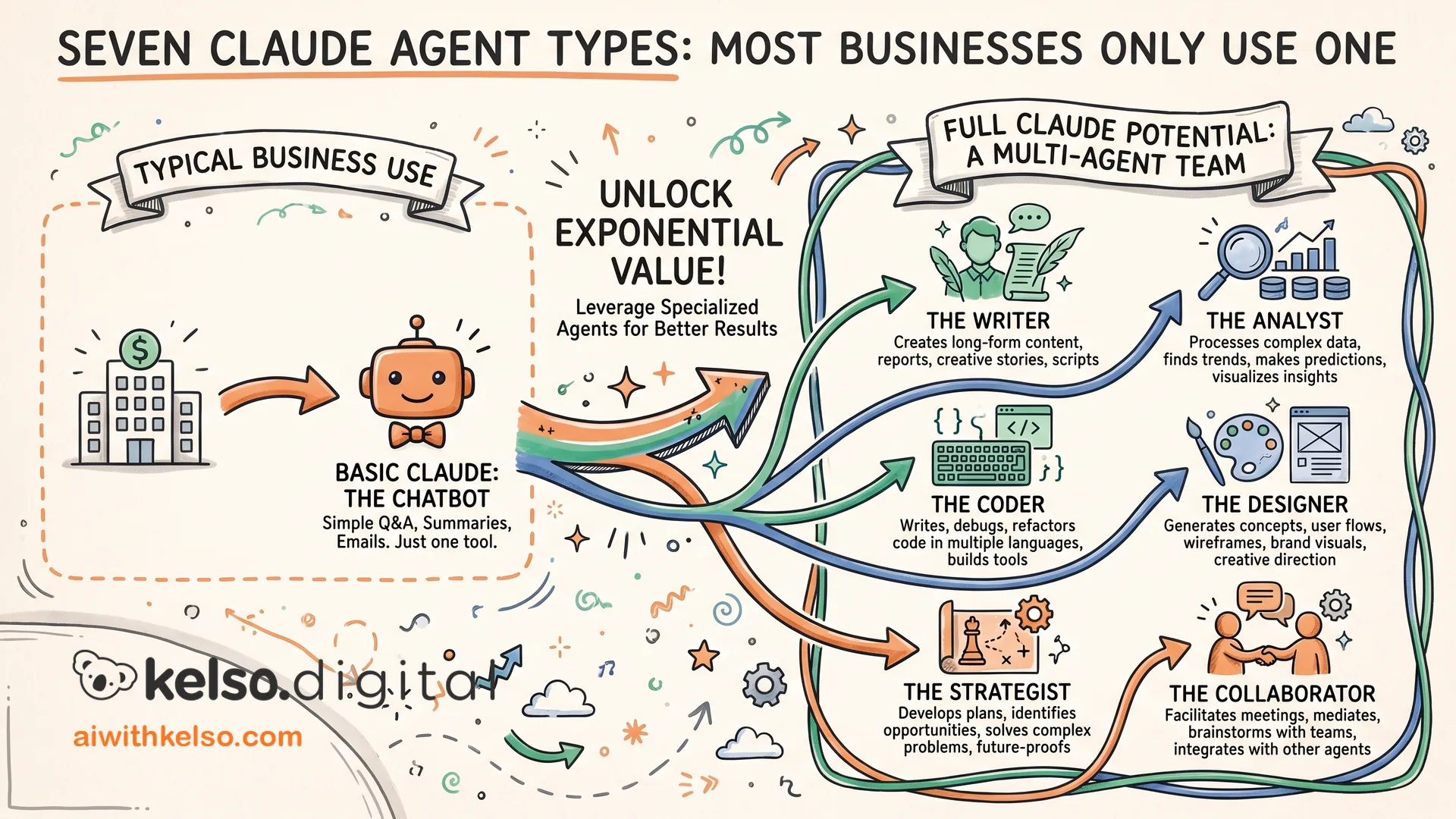
There are seven Claude agent types. Most businesses only ever use one.
The first is the basic agent. It does one task on a loop. It has no memory, no external connections, and no ability to plan past the current prompt. It is useful for simple, contained jobs, and it is where almost every business starts. Most stay there indefinitely.
The next level connects the agent to your actual tools. Add MCP servers and it links to your CRM, your calendar, your inbox. Now it is not just generating text. It is taking action inside the systems your business already runs on. That shift alone changes what is possible.
Give it memory and the whole dynamic changes again. It stops starting from scratch each session. It builds context over time, tracks what has happened, and starts behaving more like someone who knows the job than a tool you have to brief every time.
Sub-agents split the work across multiple specialised agents running in parallel. One plans, others execute. Workflows that would overwhelm a single agent run in parallel without breaking down.
The most capable type coordinates entire agent teams. Each one specialised. Each one reporting back to a central orchestrator. This is where the real compounding gains live for any business running across multiple systems, and it is where almost nobody is operating yet.
Most businesses I work with are operating at level one or two. The technology to go further exists. The constraint has never been the tools. It has been knowing what is possible and having a clear enough process to hand over.
Work out which level you are at. That is the only starting point that matters.